Noir heartbreak.
Starlight.
Waiting for sweet nothings.
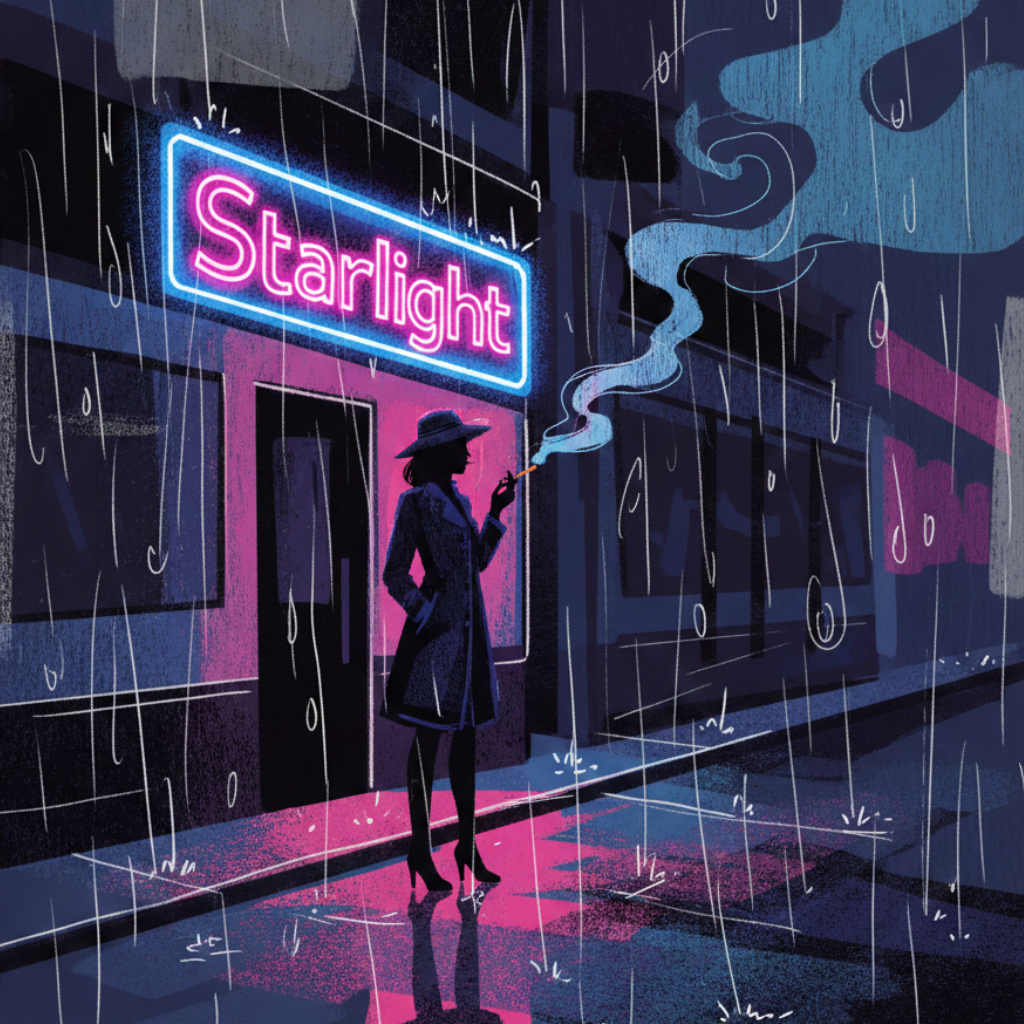
The rain starts at 3 a.m., the same hour Leo used to come home smelling of someone else’s perfume. Vera is standing in the doorway of the Starlight Club, watching the neighborhood neon signs flicker against wet pavement, and she can still smell it—My Sin, the kind of scent that costs more than her weekly take at the diner. The exact scent that clung to his collar like a confession he never bothered to make.
The bartender doesn’t ask what Vera wants anymore. He just pours two fingers of rye and slides it across the mahogany, worn smooth by a thousand other desperate hands. Vera likes that about Sammy. He understands that some questions don’t need asking, that some answers don’t want giving.
“He’s not coming back, doll,” Sammy says.
His voice is soft, almost tender. He’s been saying the same thing every night for three months now.
Vera lights a cigarette—Lucky Strike, the same brand Leo smoked—and watches the ember glow in the dim light.
“I know.”
But knowing and accepting are two different continents, separated by an ocean of bourbon and bad decisions. Vera knows many things: wounds need cleaning, debts come due, and flowers wilt eventually. But that doesn’t make the cleaning hurt any less, the bills any smaller, or saying goodbye any simpler.
Leo was a two-bit grifter with matinee-idol looks and a smile that could make you forget the difference between knowing and accepting for a moment. Vera met him on a Thursday. It’s always a Thursday when your life starts to unravel. (In her head, that rhyme repeats itself on and on and on, Thursday’s child has far to go, far to go, far to go…)
He was running a card game in the back room of The Blue Note. She was waitressing, working her sixth double in a row, when he looked up at her with those slate-gray eyes and said:
“You’re too pretty to be this sad.”
She should have walked away. Should have recognized the line for what it was—another con, another angle. But loneliness makes you stupid, and she’d been carrying around her share since her father walked out one morning and never came back, and her mother followed him in every way but physically.
Leo saw that loneliness. He collected it like other men collected stamps or baseball cards. He knew exactly what to do with a woman who’d forgotten how to hope for anything good for herself.
For eight months, he made her feel like starlight—actual starlight from some distant galaxy where things are born clean and burning, not like anything on this planet with its dirty streets and dirtier people. He made her feel like she came from somewhere vast and untouchable, like she was something precious and rare instead of just another dame working double shifts and going home to a one-room apartment with peeling wallpaper. He would show up at the diner just before closing, lean against the counter with that crooked smile, and say:
“Let’s blow this joint, baby. Let’s go somewhere the lights are low and the music is slow.”
And they would. They would dance at the Starlight—this time, not the one from some distant galaxy, but the Club. They would stay until the band packed up, until the bartender started stacking chairs, until the city outside grew so quiet, you could almost believe the real world didn’t exist.
He never promised her anything. She’ll give him that much. He never said the words “forever” or “always.” Never put a ring on her finger or his name on her lease.
But he gave her something worse. He gave her hope.
She found out about the other woman on a Monday. (Monday’s child is fair of face, goes the rhyme in her head.) There was the lipstick on his collar, sure, but also a matchbook from a hotel uptown. It was a place with doormen and elevators that don’t rattle when they climb. A place Vera had never been to, could never afford.
When she asked him about it, he didn’t even bother to lie. He just looked at her with something like pity and said:
“You knew what this was, sweetheart.”
The thing is, she didn’t. Or maybe she did, but she had convinced herself otherwise. Loneliness has a way of making you a liar, even to yourself.
He left that night, and she hasn’t seen him since. But she comes here anyway, to the Starlight, the Club, not the galaxy. She comes to her bar stool that has become her confessional. She sits there and drinks, smokes, pretends she is waiting for something other than the bottom of glasses after glasses.
Or she stands at the doorway, as she is doing so now.
Sammy has been watching her, the way bartenders do—part therapist, part priest.
“You ever think about stopping?” he asks. “The waiting, I mean.”
She takes a long drag, letting the smoke curl up toward the outside world. “Every day.”
“But you don’t.”
“But I don’t.”
Because here is the truth nobody tells you about heartbreak: it becomes its own kind of love affair. You wake up with it, wear it like a second skin, feed it with memories, “what if”s, and “if only”s. It’s the most reliable relationship you’ll ever have—loneliness that never leaves, never cheats, and never looks at you with pity, then walks out the door.
The rain is coming down harder now, drumming against the windows like it’s trying to get in.
Vera stubs out her cigarette. She returns to her stool and finishes her drink. Sammy is already pouring another, but she says anyway:
“One more.”
As if this is going to be the last “one more,” though they both know it’s never just one.
Sammy slides the glass across the bar. Vera catches it with fingers that have forgotten how to hold anything that doesn’t hurt. Through the window, she can see the streets, slick and dark and empty. Somewhere out there, probably, Leo is threading his fingers through someone else’s hair, whispering the same sweet nothings he whispered to her.
She raises the glass to her lips. She tastes the burn. It feels nice to have the warmth settle in her chest where her heart used to be.
The rain keeps falling. The neon keeps flickering. And she keeps waiting for something she knows will never come. That’s what you do when you’ve built a shrine out of suffering, when you’ve made a religion out of loss.
Sammy has started wiping down the bar. It’s the universal signal that closing time is approaching. But he won’t rush her. He never does. If what Vera is doing for Leo is called “waiting,” then Sammy has been doing the same for her. Sammy, with his forgettable face, his unforgettable loyalty. Sammy, without any sweet nothings, without any grand gestures.
Small gestures only, for Sammy.
Such as letting her wait for him, as he waits for her.
She knows she should choose this—small gestures, grand in their constancy. But she is Thursday’s child, born to unravel. The hollow in her chest is too significant. Sammy could never fill it. Or, it would take him a lifetime to fill it. So she chases the one-in-a-million. She bets on miracles, the impossible return.
On her stool, Vera lights another cigarette and watches the smoke rise and dissipate into nothing.
Just like everything else.
Just like love.