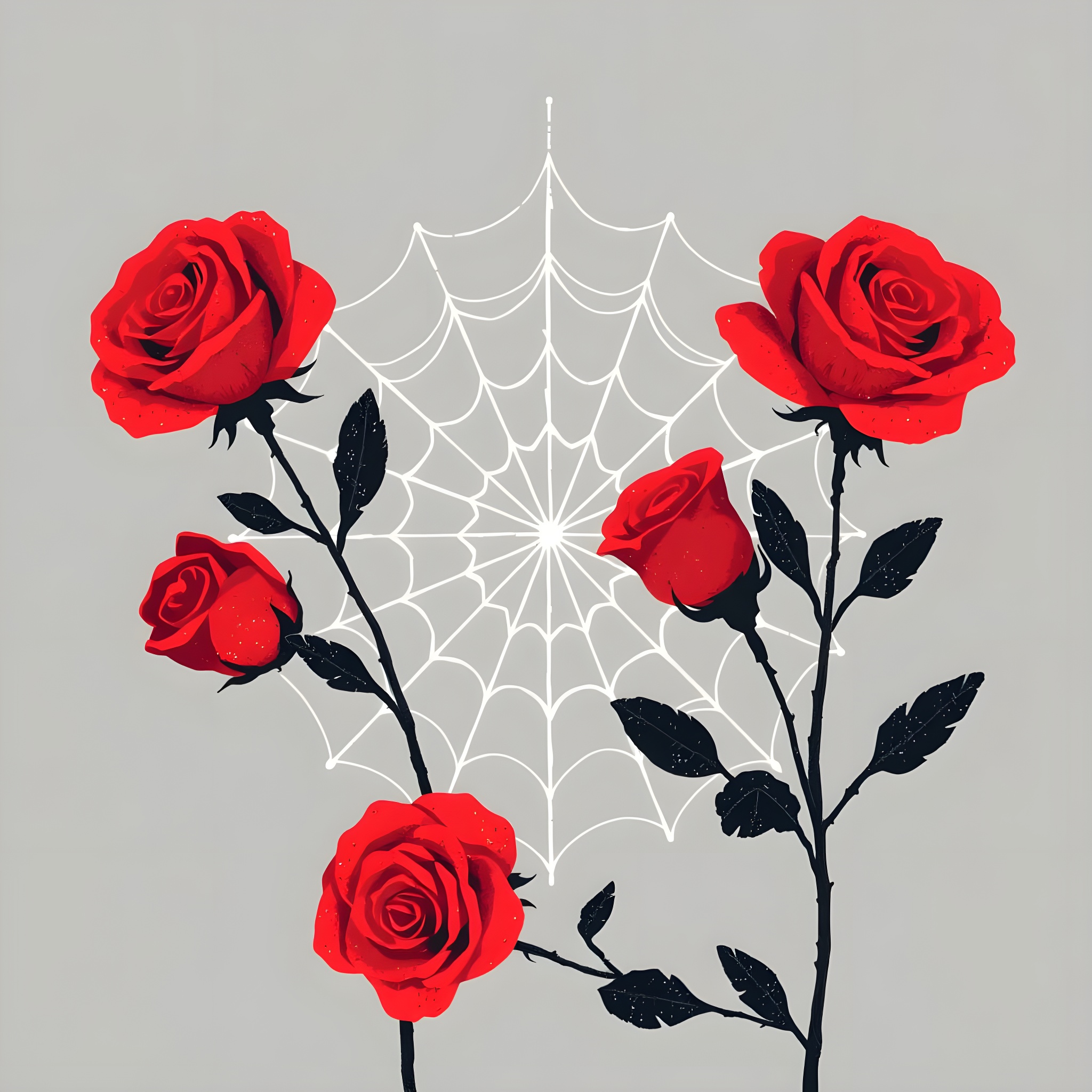
Dead husbands.
Track records and prophecies.
Not a meet-cute?
Daisy Weaver did not kill her previous three husbands. Neither was it her current hobby to weave webs of circumstance that ensnared wealthy men, old and young, to get herself a fourth husband.
Who in their right mind, in Daisy’s position, would want a fourth husband? She was only thirty, and already sick and tired of the very concept of matrimony. She happened to be heterosexual and monogamous, and somehow, the heterosexual and monogamous men she married died so easily.
Harold drowned in their bathtub after she’d merely suggested he try that new lavender bath oil. Martin tumbled down the stairs moments after she’d asked him to fetch her iPad from the bedroom. Robert choked on a piece of steak she’d seasoned with perhaps a little too much pepper.
It wasn’t Daisy’s fault that men apparently lost all survival instincts the moment they said “I do” in front of her. Each husband had barely lasted half a year, like saplings that never made it through their first summer.
Yet, here she was, faced with the danger of another meet-cute.
“I lost my previous three husbands,” Daisy declared to the man standing across her store counter.
His face crinkled with amusement. “Do you presently have a fourth husband?”
“I do not.”
“Then there is no problem.”
“Oh, there is. I do not intend to get a fourth one.”
“I wasn’t asking you to marry me right away. It’s just coffee.”
“I do not intend to do anything that might result in a fourth husband.”
“Why not?”
“I just told you. I lost my previous three husbands.”
“And that makes it impossible to have coffee with me?”
Daisy sighed. “You don’t understand. Not fully. And I do not wish it on anyone for them to understand me. So let me state this very clearly: repeatedly dying husbands really make you develop a certain sense of pessimism. Three is sort of a meaningful number. Three is when things start to feel less like a coincidence and more like a curse. If you get anywhere close to being my fourth husband, if you so much as imply that you’re remotely romantically inclined, who knows what might happen to you?”
The man’s amused face uncrinkled with what looked like genuine empathy. It seemed that he’d thought her initial explanation was a macabre deflection, an extreme way to decline his asking her out. But no. He could see now: Daisy Weaver wasn’t joking. Hence the uncrinkling of his face.
Which shook Daisy, to her dismay.
The initial crinkling had been attractive enough. But to Daisy’s surprise, the current uncrinkling was even more charming.
She tried not to pay too much attention to the man’s face. She could think about work. For example, the van that was supposed to pick up the funeral arrangements and deliver them to the funeral home would arrive in about five minutes. Yes, funeral arrangements. Her flower shop had started out with a heavy focus on wedding arrangements, but now she specialized in funeral arrangements. That was the arrangement she had with the world: Daisy Weaver was allowed a place in society so long as she stuck to endings, not beginnings.
“You think you’re cursed?” the man in front of her asked, the one she hoped to keep far away from his own funeral.
Daisy shrugged. Around them, her flower shop hummed with quiet life: roses released their perfume, tulips stood cheerfully, and baby’s breath formed cute clouds along the back wall. Daisy Weaver was no garden-variety Black Widow. Most things became livelier and more vivid when they were around her—just not men.
So, she had to remove this man from her premises while he was still alive.
“Anyway,” she said, “so, thank you, but no thank you about the coffee. And, also no thank you to the flowers. Would you still like to get them for yourself or someone else?”
Between them, on the counter, lay the bouquet of red roses that he’d attempted to buy for her from her own store while he was asking her out for coffee. Some might say his move was ridiculous, to buy a florist flowers from her own inventory. But Daisy thought it was cute. It was just that, she did not want the cute to transform into a meet-cute.
She was avoiding eye contact with this man at the moment, but she’d seen him coming and going on Main Street in the past few weeks or so. He’d just moved here. She had no idea what he did for a living. She could’ve found out easily—everyone in this neighborhood liked to gossip, and besides, talking about a new neighbor’s work was hardly harmful gossip. But something in Daisy had told her that she’d better stay away from him.
And voilà, she’d been correct. Look at him, somehow getting himself caught in the man-killing web that she never intended to weave but couldn’t stop herself from weaving.
If she didn’t want to avoid melodrama, she would’ve screamed at him, Not only is this not a meet-cute, but let’s pretend we’ve never met! Erase me from your memory! Now, begone from my store and never come back!
Through the store window, Daisy could see Jolene from the hardware store and John from the antique shop. She couldn’t see their facial expressions, but based on how they just stood there across the street, looking in the direction of her flower shop, she could tell: by the evening, new gossip about her was going to circulate—the more harmful kind.
The Black Widow strikes again! they would whisper. Another helpless man, caught in her web!
But was it really gossip, when it was simply the truth? Three of Daisy Weaver’s husbands had died in the span of five years, after all. Some accused her as much of her “eagerness to get herself new husbands” as they accused her of their deaths. The implication was that, if she’d had the decency to wait three, five, ten years between each husband, she wouldn’t have been such a horrible person even if they had died in exactly the same way.
Maybe that was true. Maybe it wasn’t. Daisy certainly didn’t know the socially approved mourning-to-courtship ratio. How many months of dating were required to properly assess a man’s likelihood of survival post-matrimony? Was there a formula?
She was only glad that there hadn’t been any life insurance policies that named her as beneficiary. At least she’d been spared that particular accusation.
“I would still like to buy them for you even if you don’t want to get coffee with me,” the man said.
Daisy had no choice but to look at him. “Sir, they are my flowers. They’ve been in this store the entire time. Buying them for me accomplishes nothing except moving money from your wallet to my register. The markup on these roses happens to be excellent. And look at them.” She nodded at Jolene and John. “They’ll accuse me of profiting from men I haven’t even married yet.”
The man crinkled his face once more in amusement. Damn this man. He was a crinkler-uncrinkler. How devastatingly effective. The transformation was unfairly charming. His eyes and mouth moved in perfect synchronization, broadcasting sincerity and humor in equal measure.
“I don’t intend to die anytime soon,” he said.
“That’s what they said,” she said.
The man uncrinkled his face, then nodded solemnly. “All right. Then I’ll just pay for the privilege of rejection and keep the roses for myself. They are beautiful roses.”
“They are,” Daisy said.
He tapped his card. The machine beeped. She handed him the receipt and the bouquet.
“Have a good day,” he said.
“Have a good day,” she said.
The entrance bell jingled cheerfully as the door opened and closed. Across the street, Jolene and John hurriedly went their separate ways, before the rejected man could notice them.
Daisy thought she could read disappointment from their body language, because nothing more dramatic than the purchase of flowers had happened. It was also possible that they could read disappointment from her body language.
It deserved re-mentioning that she was only thirty years old. Just because her three previous husbands happened to face unfortunate and untimely deaths, what, was she supposed to spend the rest of her life alone? That would mean that she had half a century of loneliness ahead of her! Heck, even if she were twice her current age, sixty years old, sentencing a person to a romance-less life would be cruel. Doesn’t a human deserve love until the day they die?
But alas, if she was honest with herself, all Daisy Weaver expected in her life at this point was the funeral van. Endings, always endings. Never beginnings. She sighed—
But the exhale got stuck in her throat.
There is a phenomenon that happens at life’s pivotal moments. Time dilates. It stretches thin. Reality narrows to a pinpoint. Suddenly, you’re not seeing everything; you’re seeing one thing with ominous clarity. Daisy Weaver had experienced this phenomenon three times in her life so far. One, when she found Harold drowned in their bathtub. Two, when she found Martin at the bottom of the stairs. And three, when she found Robert keeled over onto his dinner plate when she returned from the kitchen with his water.
Now, despite being utterly unmarried and romantically uninvolved, the phenomenon was happening again:
The funeral van entered her field of vision from the left. It was moving slowly, but it wasn’t because the whole world was moving in slow motion. The van was actually slow. That was because the driver was too distracted to properly press on the gas pedal. He wasn’t looking ahead. He was looking down at something, possibly checking the street number of his destination on his phone. Meaning: this was exactly the type of behavior before a driver snapped out of his distraction and stepped harder on the gas pedal without thinking.
In the next split second, Daisy’s eyes darted toward the crinkler-uncrinkler she’d just rejected. He had paused on the sidewalk.
Why on earth is he still here, when Jolene and John already returned to their stores? Daisy thought, when she saw that the man was ducking to pick up a single rose that had slipped free, tumbling down to roll off the curb and into the street. The man stepped off the sidewalk after it, his head bent, attention focused downward.
God damn it, I will not let them accuse me of killing husband candidates on top of actual husbands!
She rushed out of her flower shop. The doorbell jingled madly. The man glanced back at her.
She thought, Don’t look at me, you fool, move out of the way!
But there was no time to say the words out loud. Daisy took three strides. Her hand shot out. She grabbed his jacket.
She yanked him toward her.
He stumbled backward onto the curb. At the same exact moment, Daisy saw the van driver look up. And exactly as she’d predicted, the man was just emerging from his phone distraction and was now speeding up without properly checking his surroundings.
Only belatedly did his eyes widen when he noticed Daisy and the crinkler-uncrinkler. They were so close, Daisy thought she could feel heat from the van’s engine. The air lifted strands of her hair.
Oh, good. At least I don’t have to watch another man die.
But then, something held her closer—the crinkler-uncrinkler’s arm. It wrapped around her waist.
Marvelous, how relative time could be! How generous and merciful that this last sweet moment was stretching so she could perceive so much before the van crushed them or the fall cracked their skulls on the pavement…
Swoosh!
Daisy and the crinkler-uncrinkler landed on the sidewalk. Ouch! She squeezed her eyes closed in pain. Then she ripped them open. Her skull hadn’t hit the hard ground directly. She was pressed against the crinkler-uncrinkler’s chest. Somehow, this man had twisted beneath her, taking the brunt of the fall. His hand and arm cushioned her head.
Eyes wide, Daisy scrambled up, pushing him away. Was he dead? Did he not only die, but also die for her?
“Hey, hey, hey, it’s okay, it’s fine,” the crinkler-uncrinkler said.
He pushed himself up on one elbow, wincing. He rolled his shoulder and flexed his scraped hand.
He was moving. Also, he was speaking. Movement and speech. That meant…
“You’re alive,” she whispered.
Tears came to her eyes. She almost leapt up so she could proclaim to all those curious people peeking out of shop doors and windows, He is alive! He is alive!!!
But she didn’t actually do that. The relief was too enormous. He was moving and continuing to speak, apparently worried that she’d hurt her head despite his efforts to protect it. But she couldn’t move. She couldn’t speak.
His eyes were hazel. She hadn’t let herself notice that before, but now she couldn’t unsee it. They were warm like sunlight through leaves.
Also, he had a small scar on his cheek, silvery and old.
Then there were those fine lines around his eyes, lines that had crinkled and uncrinkled during their not-a-meet-cute. She’d seen them crinkle with amusement, uncrinkle with empathy, and just in general, conspire against her very reasonable desire to stay single.
But was that really her own desire? Staying single, that was. If so, then why was it that it felt so great to recall those details? As if there was already history between her and this man. A long history too! Something she’d never had with anybody before!
The van made a screeching sound. That was when Daisy snapped out of her reverie.
The vehicle had kept driving for a dozen feet, and had only now stopped. Roses were scattered everywhere around them.
The driver got out of his vehicle.
“Oh, my God,” he said. “I’m so sorry. I am so so sorry. Are you all right? Both of you? I, I, I’ll call 911…”
“I’m fine,” Daisy said, eyes returning to the crinkler-uncrinkler.
“I’m fine too,” the man said. It seemed that he had never looked away from her at all.
From nearby, Daisy recognized the voices of Jolene, John, and other neighbors. The small crowd was whispering. That took Daisy further out of her reverie.
She looked away from the man, at the scattered roses.
“See? This is what I meant. This is what happens within five minutes of asking me out for coffee. You could’ve died.”
“What are you talking about?” the man said. He gently put his hand on hers. “You saved my life.”
“That’s exactly the problem. The reason you needed saving, in the first place, was because you got tangled up with me.”
“You’re giving yourself way too much power,” he said, then glanced at the small crowd. He leaned closer toward her and said, “You’re not a curse. Nobody can have that kind of power over someone else. I dropped a rose. I stepped into the street without looking. And he drove while being distracted. What you did was save me.”
Daisy took all that in. He sounded so certain. Something in her chest cracked open.
She cried. It was pathetic and the only reasonable behavior, all at the same time.
The whispers from the crowd stopped. Jolene took a step forward, then hesitated. John cleared his throat. Someone else said quietly, “Poor thing.”
Daisy couldn’t tell if this was meant kindly, or if it was going to be another layer of gossip. Frankly, she didn’t care.
Because, now the crinkler-uncrinkler picked up a rose from the sidewalk. He offered it to her.
“Here. You saved this too.”
Indeed. Somehow, this one rose had survived the accident intact. All of its red petals were perfectly unfurled—velvet-soft, defiant, flawless.
“We need bandages,” the man said, still holding the rose in front of her. “And maybe some ice. After that…” He looked at the crowd and at the other roses on the ground. “We’re surrounded by roses and witnesses. Seems like as good a time as any to make this official.” His face crinkled with gentle humor. In a low voice that only she could hear, he said, “Do you consent to having coffee with me?”
Daisy wiped her tears away. This guy. He was persistent. And despite everything, she found herself a bit grateful for that.
Maybe she wouldn’t have to spend the rest of her life alone. Not that she was dreaming of a wedding with this man already, God, no. But even if their history ended with just coffee… He had already changed everything.
So, she accepted the rose and said, “I do.”
He got up. He offered his hand. She took it. Got up.
The crowd didn’t clap. But at least it didn’t whisper either.
Daisy Weaver didn’t know much about this man, this crinkler-uncrinkler, this buy-roses-from-a-florist’s-own-shop guy. But as she walked away from her flower shop of endings, falling into step beside him, she thought: perhaps her unfortunate matrimonial track record would turn out to be just that—a track record, not a prophecy.