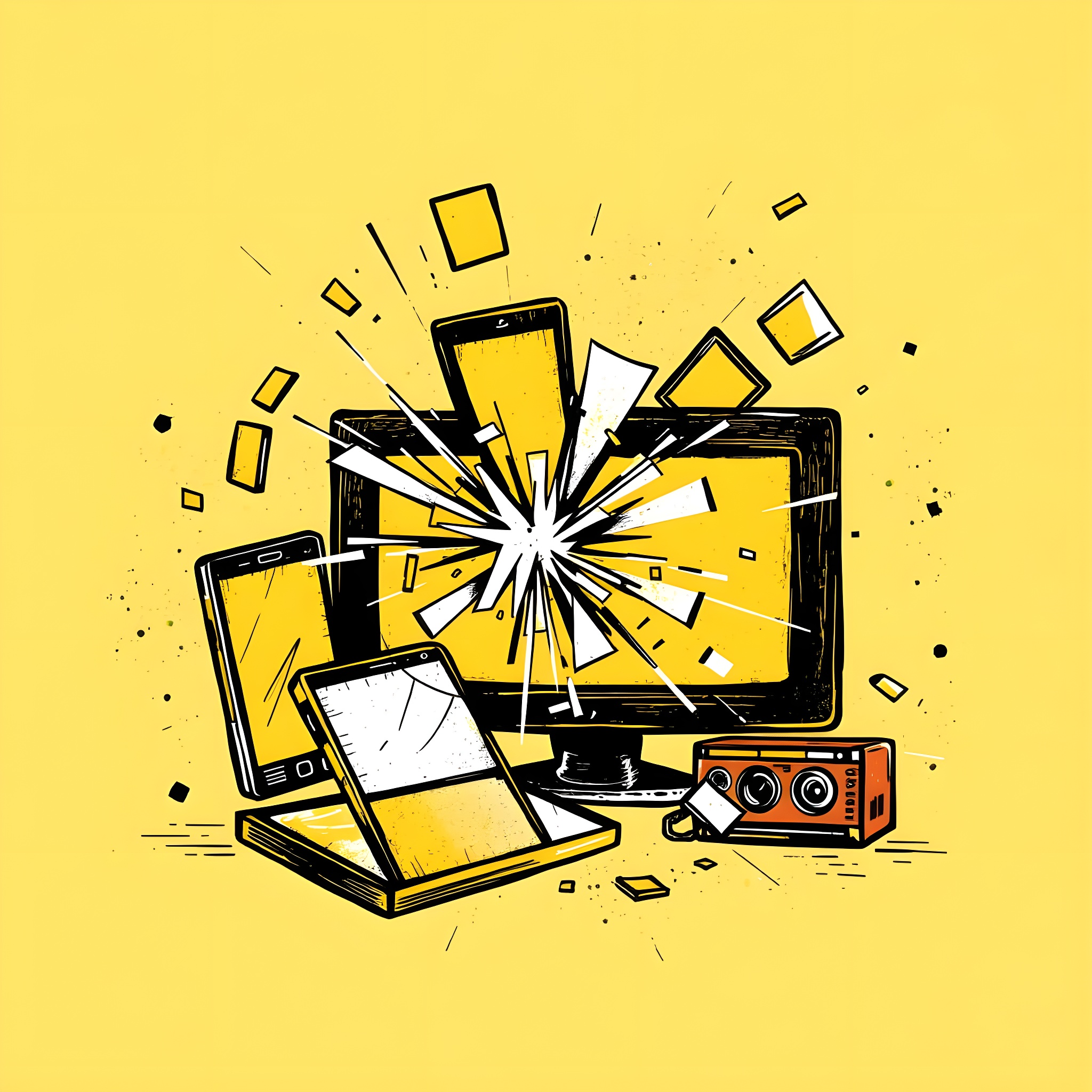
Absurd ritual.
Sanctioned destruction.
Devices dead and alive.
The waiver is five pages long. Nettie signs without reading, her fingernail tapping against the Apex Slate screen—itself a relic from sometime in the late 2010s, she notes with dark amusement. Not that Nettie is a model-year-memorizing nerd when it comes to Apex Slates and Apex Technologies products in general. It’s just that the thing still has a headphone jack, that endangered species of ports.
How apt that this establishment should have an older model as the first point of contact for its customers. No business wants to come across as one that destroys all and preserves nothing—even a place built on breaking things. It needs to convey a sense of lasting value.
Well. Let’s see if it can actually deliver.
“Right this way,” says a man, handing Nettie a pair of safety goggles and black disposable coveralls.
Hugh K, says his name tag. He looks like a perfectly normal guy in his twenties. He is what they call a “facilitator” around here, and like all facilitators, he is wearing black scrubs.
Nettie accepts the goggles and coveralls. She is starting to really like this place. It has a sense of dark humor. Hugh K looks like a nurse in a hospital for entities that have never lived. He doesn’t need to see stains and fluids on his scrubs, because the patients he deals with do not leak bodily fluids and aren’t here to be revived anyway. Heck, that word, “patients,” feels so wrong. The thing Hugh K is here to facilitate and the thing Nettie is here to commit is the opposite of revival.
Hugh K leads Nettie through a door marked SHATTER SUITE 4.
The room is larger than she expected. It’s about the size of her first studio apartment. But that makes sense. Some people probably bring stuff that takes up a lot of space. Fridges. Microwaves. An entire truckload of life.
The walls here are lined with gray foam padding like a recording studio. In the center stands a sturdy metal table, and on it lie her devices—none as large as fridges and microwaves. No appliances. Just, you know, devices. Belongings that fit into your bags and pockets. Hugh K brought them here while she was reading and signing the waiver. In total, there are seven devices in a neat row, like evidence at a trial.
Yes. Evidence and trial at Shatter Suite, for an endeavor so far, very far from revival.
Now Hugh K gestures to a pegboard on the wall. It displays the tools of destruction: hammers of various sizes, a baseball bat, a crowbar, and something that looks like a medieval mace.
“Take your time choosing,” he says. “Most people go for the sledgehammer, but we’ve got whatever speaks to you.”
Nettie reaches for a regular claw hammer, the kind her father keeps in the garage. The wooden handle feels cool, worn smooth by previous hands.
“Goggles on,” Hugh K reminds her. “If you need anything or when you’re done, press that button over there.”
He gestures at a big red button on the wall next to the door. Then he leaves the shatter suite. The door shuts after him.
Nettie puts the hammer down on the table for a moment. She slips into the coveralls and puts on the goggles. Then she approaches the table once more. Her oldest Apex Phone stares up at her, its rose gold exterior scratched but intact. She picks it up.
She had loved this phone. Loved it. It had been sleek and fast, and the camera had made her feel like an artist, catching the particular slant of autumn light through her college dorm window.
But then came the update. Apex System 14 or 15, she can’t remember which. The phone had slowed to a crawl overnight, apps freezing mid-swipe, the battery dropping from 70% to dead in the span of a text message conversation. The gal at Summit Desk, the in-store technical support service of Apex Technologies, where customers got help troubleshooting devices, had shrugged with genuine sympathy. The implication was clear: Not the phone’s fault, just progress, just how things go. Then she suggested that Nettie upgrade.
Now Nettie puts the phone down. Her hand goes for the claw hammer once more. She feels like an executioner preparing to swing at something that’s already dead—mercy and murder, all at once.
Sure, that gal at Summit Desk had been right. It’s not the fault of the phone. Its creators made it the way it is.
Oh, yes, absolutely. Nettie is sure of this. Some people call planned obsolescence a “conspiracy theory” and others claim incompetence rather than malice. But Nettie believes in none of that. She believes Apex Technologies did this, is doing this, and will keep doing this for decades to come. Deliberately, it will keep designing products that have a limited useful life. Machines can theoretically live forever, but that company dooms them to death, just like humans.
There is something tragic about that, so tragic and wrong, that Nettie feels it to be her duty to give this phone its actual proper undeniable final moment. None of the wishy-washy “we didn’t intend our products to be so short-lived,” blah blah blah. She wants a total and unambiguous “The End” for her phone. It’s the least it deserves.
Because, it’s not the phone’s fault.
And if it’s not Apex Technologies’ fault, then it certainly isn’t Nettie’s fault.
She lifts the hammer. Brings it down.
Crack!
Nettie is shocked by both the sound and the tactile sensation. They are sharp, violent, and…
…satisfying.
She lifts the hammer once more, and brings it down.
Crunch!
How glorious! The glass, plastic, and metal surrender to physics. The screen spiderwebs into a thousand tiny territories.
Harder and harder, Nettie hits. The phone skitters across the metal table. The back casing splits. Components shoot across the room like champagne corks.
Nettie stops. She is breathing hard. She is also, she realizes, giggling.
She is so glad Hugh K isn’t here to witness her state. Clearly, she doesn’t need any facilitating from him.
Next is the Apex Slate. It’s probably a generation or two older than the one in Shatter Suite’s lobby, the one with which she just signed the waiver. Hers came with 32GB of storage that had seemed infinite in 2017. It had been her portable studio, her recipe book, her evening entertainment. She’d drawn on it with the Apex Technologies Precision Stylus—terrible sketches of her cat or grocery lists disguised as art.
But then came the Apex System update that her Slate could no longer install in a way that functioned. Either the device was left stuck, loading forever, or Nettie was locked out of new features, unable to run half her apps.
Some such phenomena are inevitable as technology becomes bulkier. Apps grow heavier. Graphics become more demanding.
But some of the phenomena are oh-so-very-avoidable, especially because her Slate’s processor itself is still perfectly capable. Apex could have made the bloatware optional or let users uninstall pre-loaded apps. But instead, every update crammed in more unskippable features, more background processes, and more animated widgets that de-animated everything else.
Intentional suffocation. That is the crime Apex committed and is committing. And so, Nettie brings the hammer down on the Slate’s smooth glass face, this device that has itself done nothing wrong.
Crack!
Crunch!
She hits it again and again, each impact sending a jolt up her arm, a release.
Five devices remain, one of which is evidence that Apex isn’t alone in its business practices.
Here it is, her old Nexus Mobile phone. She’d switched to Nexus during her brief rebellion against the Apex ecosystem. Nexus Mobile’s promise of freedom and customization had seemed appealing, and the phone had been fine for six months.
Then the same-old-same-old happened. No updates or bulky updates or mandatory updates. Yada Yada yada.
The hammer comes down like a judge’s gavel.
Nettie is laughing now, really laughing, not just giggling. She sounds unhinged. For the next one, she switches her weapon from the hammer to the baseball bat.
Thud. Whump.
Huh. So this is how a baseball bat sounds different from a hammer, when you’re beating the soul out of an undead device. Or is this the difference between a music device and the rest?
SoundCore had been the dedicated music player she’d carried everywhere in high school. It had held her entire musical identity, 100,000 songs she’d carefully curated, a sonic map of who she’d been. It had stopped syncing with SoundSync in 2018 when Apex Technologies changed something, some protocol or format. Nettie had tried every online tutorial and every forum suggestion. But nothing worked. Eventually, she’d just put it in a drawer.
Until now.
Whoom!
Smash!
Three swings, and the casing splits open. This SoundCore is done. Should Nettie switch her weapon for the next one? No, not yet.
Whoom!
Smash!
…
..
.
..
…
We won’t go through each and every device remaining on the metal table of Shatter Suite 4. There is no need. It’s the same story, over and over again. Nettie keeps giving them their undeniable, unambiguous death…
…until nothing is left.
She drops the mace. Her shoulders ache. There is glass in her hair. She tells herself to remember: During the exit survey, I must suggest they give customers helmets instead of just goggles.
Goggles simply don’t suffice. What people come here for is so violent. It’s so necessary.
Nettie looks around. The table is no longer gray metal. It’s a mosaic of shattered glass, cracked plastic, and twisted circuit boards. So is the floor. It glitters like the night sky without light pollution. Each and every shard catches the light overhead.
Nettie realizes she is trembling a little. How strange to feel so shaken, when she was the one who made the decision to come here. Besides, it’s not like she is acting abnormally. There is now an entire industry of businesses like Shatter Suite. Their website has testimonials from hundreds of people.
Better than therapy, one person from Maine said.
I cried the whole time and it was perfect, another person from Ohio said.
This catharsis lasts, yet another person said, which was what had finally compelled Nettie to book an appointment.
Yet, how odd to need this absurd ritual at all.
How weird, in general, to be so affected by the death or life of digital devices.
Or is it weird to think that it’s weird? Isn’t this basic decency?
Nettie presses the red button.
“Hey, what’s up?” Hugh K’s voice says through the speakers.
He sounds neither ecstatic nor mournful. Funeral directors might use this tone. Or divorce lawyers. Or bank tellers during a robbery.
“I’m done,” Nettie says.
Within moments, Hugh K enters, holding a broom.
“Please take off the coveralls here, so nothing sharp gets into the hallway. Also, the goggles.”
Nettie complies.
“Just put them on the table right here. Thank you,” Hugh K says. “Would you please complete the exit survey on your way out?”
“I will,” Nettie says.
As she leaves, she can hear Hugh K sweeping the results of her sanctioned destruction into a pile.
In the lobby, a woman sits clutching a canvas bag that bulges with rectangular shapes. She looks uncertain yet so certain. Her eyes are bright with anticipation, that part is for certain; it’s just that she doesn’t know what exactly she is anticipating.
Nettie touches the screen of the outdated Apex Slate. It awakens. With the equally outdated Precision Stylus, she writes “helmets instead of goggles” somewhere in the exit survey. Then she retrieves her own canvas bag, very similar to the woman’s, from the locker. She leaves the locker key on the front desk. For some reason, once again, she is glad that Hugh K isn’t here. She doesn’t want to see him again. It’s not his fault.
Outside, the afternoon sun is sharp. Nettie’s phone—her current phone that doesn’t yet need a trial or ritual—buzzes in her pocket.
Reflexively, she checks the notification. It’s an email from Shatter Suite.
Thank you for your visit! Schedule your next appointment and save 15%!
One of these days, someone will shatter Shatter Suite.
Shaking her head, Nettie keeps walking.